


Facilitating the discovery of European myths and legends and fostering discussion around these iconic stories involves making choices not only from an extremely rich body of foundational tales, but also from the multitude of narratives that have been created from them.
Present in all cultures, their evocative power is strong. Belonging to the oral tradition, they transcend the oral/written dichotomy and form part of a universally shared practice. We can therefore assume that no one is ever completely lost when faced with an unfamiliar myth. They are also fascinating because they allow us to explore the concept of narrative: its structure, its characters, its narrator(s), and thus questions of perspective, temporality and how this affects meaning. A story can indeed be told in many different ways.
In the context of learning a foreign language, mythological narratives are all the more interesting given that teaching for adults and young adults does not make sufficient use of storytelling. Yet, if we think about it, we spend our time telling stories: events, tales, jokes. Migration journeys and career paths are stories; the discoveries, surprises, and both pleasant and unpleasant experiences that come with arriving in a new country are stories; the people we meet there are stories too.
So, it is crucial to know how to tell them.
Myths, in the apparent simplicity of their narrative, invite us to seek out complexity, to ask why the heroines and heroes acted as they did, and to explore what the myth reveals behind the action. The Pictomix leporellos, with their illustrations, encourage us to do just that.
But which myth to choose?
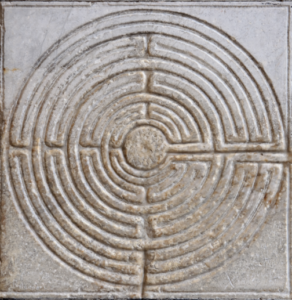
The myth of Theseus and the Minotaur is striking. No doubt this is because of the labyrinth, where anyone who enters is lost forever, and the tragic, abandoned and monstrous figure of the Minotaur. But surely also because salvation comes from a simple thread. A stroke of ingenuity that Ariadne, in love, took the risk of seeking from Daedalus the architect, a thread she took the risk of holding at the entrance to the labyrinth.
Yet it is Theseus, the independent and courageous hero, whom the accounts of this myth generally focus on. As in the telling of many ancient myths, the hero takes centre stage.
As Murielle Szac points out, ‘the stories of gods and heroes have come down to us solely from a male perspective’1. Indeed, these tales—which were initially passed down orally—were transmitted by men, ancient bards who made them their own by reinventing parts of them, whilst women did not fulfil this role. Nor, however, do we find women later among the poets and playwrights who passed on these ancient myths.
Delving into Greek mythology seems very much like entering a male-dominated world. And yet, these tales tell of much more than stories of heroes and battles. It is these that we remember, for they are the dominant narratives of the myths that remain in our minds.
The world is changing; today, the context in which myths are circulated and read has changed. We are taking a fresh look at mythology, through which it becomes clear that women in Greek mythology do not play a secondary role.
We have therefore chosen instead to follow a different life path from that of Theseus, a different starting point, different aspirations and questions, and different choices; for this is essentially what mythological tales are all about. ‘Myths were born to offer an explanation for the inexplicable, to contemplate what the mind struggles to imagine, to question the forces at work within us, to articulate what underpins our humanity’2.
It is Ariadne, a strong and powerful woman, that this leporello dedicated to this mythical tale will follow.
Ariadne’s thread
And it is Ariadne and her thread that we, in turn, have followed. This thread is the one that allows one to wander without becoming completely lost, the thread that intertwines life and death, the one that weaves life.
Without this thread, Theseus, the vanquisher of the Minotaur, would have died, lost in the tomb that is the labyrinth. Following it brings him back to life.
At the other end, Ariadne holds it, awaiting her lover’s return. Ariadne, who through her actions betrays her father. A passionate, fearless and determined Ariadne.
If Ariadne betrays, leaves her beloved island, chooses exile to follow the man she loves with whom she has made a pact, this betrayal allows her to win her freedom.
Later, she was left alone on the island of Naxos, where Theseus’s ship had docked when, taken ill in the storm, she needed rest. It matters little why Theseus set sail without her. She loved him, but it was without him, on this island, that she would build her life. It is also there, in our leporello, our story, that decades later she retraces the thread of her memory to recount her choice and her tale of courage.
For the true heroine of this episode is indeed her. Without her, Theseus, the future king of Athens, would have died in Crete.
Further reading
SZAC, Murielle. L’Odyssée des femmes. Paris : Editions de l’Iconoclaste, 2023, 295 p.
Collectif des Jaseuses. Brouillon pour une encyclopédie féministe des mythes. Donnemarie-Dontilly : Editions Ixe, 2023, 280 p.
OVIDE. Métamorphoses, Livre VIII, Arles : Actes Sud, 700 p.
GIDE, André. Thésée. Paris : Gallimard, 1946, 132 p.
To listen to
Le book Club, « La place des femmes dans les mythes », France Culture, 9 novembre 2023.
https://www.radiofrance.fr/franceculture/podcasts/le-book-club/la-place-des-femmes-dans-les-mythes-7001419
Illustrations
- Digital photo of labyrinth carved on a pillar of the portico of Lucca Cathedral, Tuscany, Italy, cropped. The inscription that was cut is in Latin: inscription says "HIC QUEM CRETICUS EDIT. DAEDALUS EST LABERINTHUS. DE QUO NULLUS VADERE. QUIVIT QUI FUIT INTUS. NI THESEUS GRATIS ADRIANE. STAMINE JUTUS", i.e. "This is the labyrinth built by Dedalus of Crete; all who entered therein were lost, save Theseus, thanks to Ariadne's thread."
Source: https://commons.wikimedia.org/wiki/File:Duomo_Lucca_cathedrale_Lucques_labyrinthe.jpg
↩︎ - Portrait of Ariane, daughter of Minos
Source : https://gallica.bnf.fr/ark:/12148/btv1b10335695c?rk=42918;4
↩︎